
My grandfather’s fate after the fall of Singapore had always been unclear. Recently I found out that the University of Melbourne Archive (UMA) had digitized their collection of Australian Red Cross (ARC) POW World War II enquiry cards. These cards were used to record requests for information, usually by family members in Australia, as to the whereabouts of prisoners of war.
It can be tricky to find the best place to search the card collection. The cards are owned by UMA. After digitization the collection became searchable via the Library repository. To get some background:
- start with this page from the UMA exhibition of their Australian Red Cross collection.
- there is an an informative blog post about the collection and the content of the cards
- here is the record in the repository for the entire card collection.
- To retrieve all the cards use this search
- To search for a particular name enter it at the end of the search box. Find the relevant record for the card you want. From within the record click on the link to the ‘digital resource’ to find a pdf of the card.
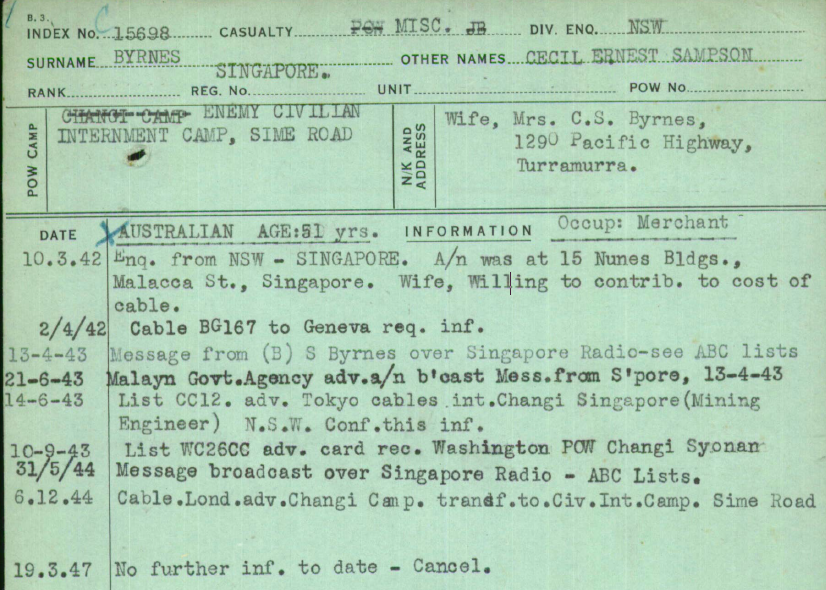
Here is a link to Cecil’s ‘Missing, Wounded and Prisoner of War Enquiry Card‘. For convenience I’ve copied a section of it below.
The information on the cards is very condensed so the UMA provides a list of the most common abbreviations.
From the card we can see that Cecil was a civilian, the enquiry came via the NSW branch of the ARC, and that he was initially in the Changi Camp before being transferred to the Enemy Civilian Internment Camp at Sime Road. The ‘next of kin box’ shows Lily’s contact address as 1290 Pacific Highway, Turramurra. Cecil is said to have been 51 years old, although I believe he was 49 at the time. His occupation is ‘merchant’ which is suitably vague. During the 1930s he was managing a tin mine at Panang but he was a certified accountant and had been involved in various commercial activities.
10-3-1942 Cecil’s address is given as 15 Nunes Building, Malacca Street, Singapore. These photos from 1982 show the Nunes Building past its prime but in its day it was in an important commercial hub. To gain an impression of what the area was like during the 1950s I can recommend Naffi’s Reminisces of Dad, 1952-1960. This card entry mentions that Lily is willing to contribute to the cost of the cable. I wonder how much it was.
2-4-1942 a cable is sent to Geneva requesting information.
13-4-1943 and 21-6-1943 a year passes. I don’t know what these entries mean. ‘Message from (B) S Byrnes over Singapore Radio – see ABC lists’. More research needed.
14-6-1943 List CC12 advises Tokyo cables: interned in Changi. The mention of ‘mining engineer’ is plausible. In 1931 Cecil became a member of American Institute of Mining and Metallurgical Engineers. Looks like NSW ARC checked this detail with Lily as initially his occupation was given as ‘merchant’.
10-9-1943 List WC26CC advises card received Washington POW Changi Syonan (Japanese for Singapore). This seems to confirm that Cecil is in Changi POW Camp.
31-5-1944 another radio broadcast
6-12-1944 a cable advises that Cecil had been transferred from Changi to the Civilian Internment Camp at Sime Road.
19-3-1947 no further information available so the case is closed.
In the meantime the war in the Pacific had ended in August 1945 so presumably Cecil was released soon after then. Cecil appears to have been incarcerated for a total of 3 1/2 years, from the fall of Singapore in February 1942 until its liberation in September 1945.
Here is an interesting blog post describing the Sime Road camp.
And here is a listing for Cecil on the FEPOW website.
The University of Cambridge Digital Library has a collection entitled ‘Voices of civilian internment: WWII Singapore‘, which includes the ‘Changi and Sime Road civilian internment camps: nominal rolls of internees (RCMS 103/12/22)‘ which lists Cecil. Cecil’s camp register number is listed as 2013, card index number 305, age 49, occupation miner, nationality Australian.